Benchmarks
Caddy Snake runs Python in worker subprocesses managed by the plugin over a Unix domain socket, avoiding a separately configured Gunicorn or Uvicorn server and the extra HTTP hop of a traditional reverse-proxy setup. The harness compares Flask (WSGI), FastAPI (ASGI), and ESGI (gevent) on a minimal JSON GET /hello endpoint. The table below matches the committed benchmarks/results.json, produced on a 4 vCPU / 16 GB cloud VM (linux/amd64) via the Docker harness (benchmarks/Dockerfile).
Test configurations
| Configuration | Description |
|---|---|
| Flask + Gunicorn + Caddy | Gunicorn (1 worker, 4 threads) behind Caddy reverse proxy |
| Flask + Caddy Snake | Flask served directly by Caddy via caddy-snake (process worker) |
| FastAPI + Uvicorn + Caddy | Uvicorn (1 worker) behind Caddy reverse proxy |
| FastAPI + Caddy Snake | FastAPI served directly by Caddy via caddy-snake (process worker) |
| ESGI (gevent) + Caddy reverse proxy | The same caddysnake.py gevent ESGI StreamServer used by workers, listening on a Unix domain socket with Caddy proxying HTTP to that socket |
| ESGI + Caddy Snake | The ESGI app served via module_esgi / runtime gevent inside the plugin |
All configurations return the same JSON body: {"message":"Hello, World!"}.
Results
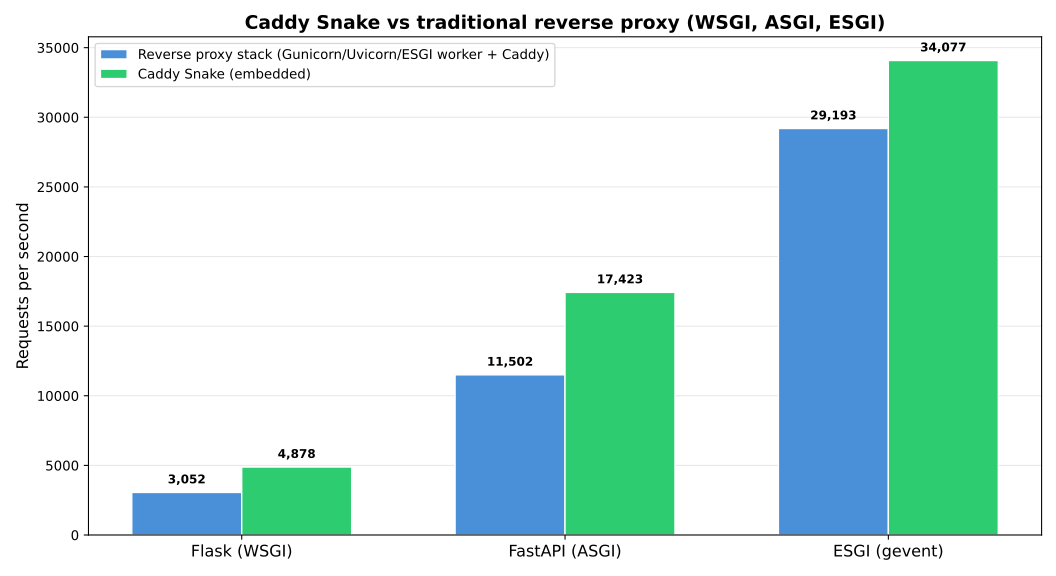
| Configuration | Requests/sec | Avg Latency (ms) | P99 Latency (ms) |
|---|---|---|---|
| Flask + Gunicorn + Caddy | 3,052 | 32.70 | 37.68 |
| Flask + Caddy Snake | 4,878 | 20.49 | 28.25 |
| FastAPI + Uvicorn + Caddy | 11,502 | 8.70 | 91.46 |
| FastAPI + Caddy Snake | 17,423 | 5.72 | 8.85 |
| ESGI (gevent) + Caddy reverse proxy | 29,193 | 3.43 | 9.97 |
| ESGI + Caddy Snake | 34,077 | 2.95 | 8.10 |
Highlights on this hardware:
- Flask: Caddy Snake serves ~60% more requests/sec than Gunicorn behind Caddy, with ~25% lower P99 latency.
- FastAPI: Caddy Snake serves ~51% more requests/sec than Uvicorn behind Caddy. The P99 gap is the most striking: 8.85 ms vs 91.46 ms — the embedded path avoids the upstream TCP hop and Uvicorn's accept-queue jitter under 100-connection load.
- ESGI: the pair is closest because both rows run the same gevent gateway code from
caddysnake.py; the embedded wiring is still ~17% faster than proxying HTTP over a Unix socket.
Methodology
- Tool: hey
- Concurrency: 100 connections
- Duration: 10 seconds per test run
- Warmup: 200 requests at 10 concurrency before each configuration
- Repeats: 10 runs per configuration, averages reported
- Platform (published numbers): 4 vCPU / 16 GB cloud VM, linux/amd64
- Python: 3.13 (inside Docker Ubuntu 22.04 image from
benchmarks/Dockerfile) - Go: 1.26
- Workers: Caddy Snake uses one process worker in the benchmark Caddyfiles; Gunicorn uses 1 worker with 4 threads; Uvicorn uses 1 worker; the standalone ESGI line uses one
caddysnake.pyESGI server process
Reproduce
Dedicated instance (Scaleway POP2-2C-8G)
For stable numbers on a clean dedicated instance, see benchmarks/scaleway_bench.sh (Scaleway CLI + SSH). Example:
BENCH_RSYNC_LOCAL=1 BENCH_SSH_IDENTITY="$HOME/.ssh/id_ed25519_scw" ./benchmarks/scaleway_bench.sh
Any machine (Docker)
docker build -t caddy-snake-bench -f benchmarks/Dockerfile .
docker run --rm -v $(pwd)/benchmarks:/workspace/benchmarks caddy-snake-bench
Results go to benchmarks/results.json and benchmarks/benchmark_chart.{png,svg}. Copy the SVG into the docs site when publishing updated figures:
cp benchmarks/benchmark_chart.svg docs/static/img/benchmark_chart.svg
What the benchmark does
- Builds Caddy with the caddy-snake plugin from source
- Creates a Python 3.13 virtual environment with Flask, FastAPI, Gunicorn, Uvicorn, uvloop, and gevent (for ESGI)
- For each configuration: start servers, wait for
GET /hello, warm up, then benchmark with hey (100 concurrent, 10 s) for 10 runs; record requests/sec, average latency, and P99 - Writes
results.jsonand generates the comparison chart